
Sub Item 3 (H5)
Sub Item 4 (H6)
Food brands often ask whether kraft paper bowls or white paper bowls are the better choice for takeaway, salad, soup, rice, dessert, or meal-prep packaging. The pressure is understandable: packaging color affects shelf impression, delivery photos, brand consistency, and even how customers perceive sustainability. But the wrong comparison can lead buyers to focus on the bowl exterior while missing the factors that actually affect performance and compliance.
Conclusion: Neither kraft nor white paper bowls are universally better. Kraft paper bowls and brown paper bowls often support a natural, artisanal, or sustainability-led brand image[1], while white paper food bowls usually offer a cleaner base for accurate Pantone colors[2], detailed artwork, and complex custom printing. Functional performance depends more on paperboard grade, coating, bowl structure, food-contact safety[3], and manufacturing control[4] than on whether the outside looks brown or white.
For B2B buyers, the practical question is not “Which color is more premium?” but “Which substrate supports our brand system, food application, order volume, cost target, and supply plan?”
Kraft vs White Paper Bowls: A Branding Decision, Not Just a Color Choice
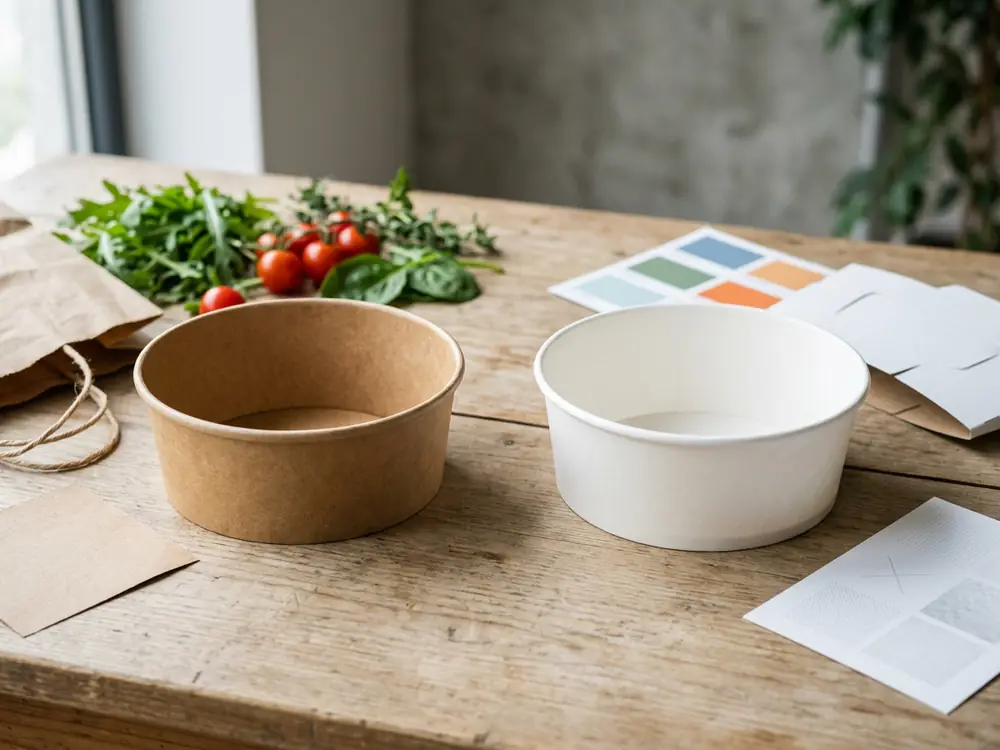
Kraft paper bowls are often selected because they communicate a specific visual language. They feel natural, rustic, casual, handcrafted, organic, and environmentally conscious[5]. That makes them a strong fit for healthy food brands, salad and grain bowl concepts, organic cafés, bakeries, natural food retailers, and restaurant brands that want a softer, less industrial look.
White paper food bowls create a different signal. They look clean, modern, controlled, hygienic, minimal, and often more standardized. This is useful for chain restaurants, dessert brands, franchise systems, premium takeaway concepts, and brands that rely on bright colors, photography, or highly recognizable visual assets.
The key point is that visual perception is not the same as material performance. A kraft surface may look more eco-conscious, but that does not automatically mean the bowl has a lower environmental impact[6], better recyclability, or safer food-contact behavior[7]. Those outcomes depend on fiber sourcing, coating choice, basis weight, production efficiency, certifications, and local end-of-life systems.
In my experience working with food packaging buyers, the strongest packaging decisions start with brand positioning. If the brand language is earthy and simple, kraft may support the message. If the brand depends on color precision and consistent graphic presentation across many locations, white paper is often safer.
Color Reproduction and Pantone Performance: Why White Paper Usually Works Better for Complex Branding
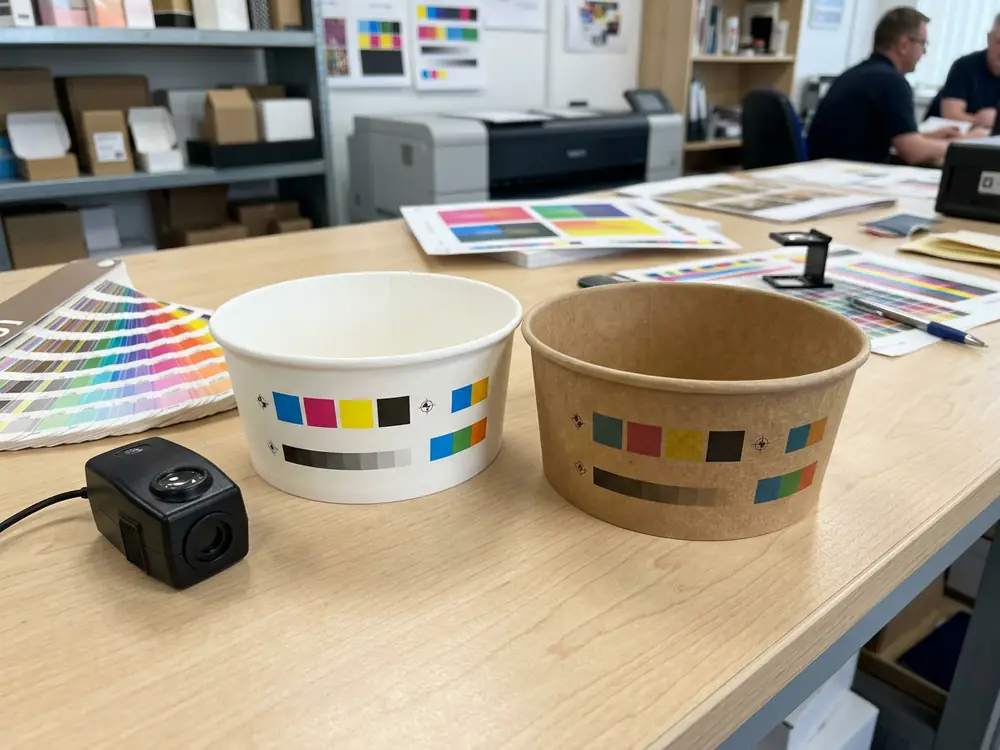
For custom paper bowls, the paper base directly affects printed color. White paperboard gives printers a neutral, brighter background, so CMYK, spot colors, and Pantone references are easier to control[8]. Kraft paper has a brown base tone, which can shift colors and reduce brightness.
This matters when a brand uses strict color standards. The same Pantone color can look noticeably different on white paper and kraft paper, even with the same ink and printing process[9]. Light colors, pastel tones, gradients, skin tones, product images, and high-saturation colors are more vulnerable to change on kraft.
What Designs Usually Work Better on Kraft Paper Bowls?
Kraft is more forgiving when the design is intentional and restrained. It works well with dark logos, black or deep green graphics, simple line art, limited ink coverage, and a design system that allows the paper texture to remain visible. Many brands use kraft bowls with one-color or two-color printing to reinforce a natural look instead of fighting the substrate.
What Designs Usually Work Better on White Paper Bowls?
White paper is usually better for large logo areas, bright brand colors, product illustrations, gradients, QR codes, nutritional callouts, seasonal campaigns, and detailed artwork. If a brand needs the same red, blue, orange, or green to appear consistently across cups, bowls, bags, and cartons, white paper gives the production team more control[10].
At Econly, six-color printing machines, flexographic and offset printing options, and pre-production sampling help buyers compare real output instead of relying only on digital artwork. For high-volume custom paper bowls, the right print method can improve consistency and cost efficiency. For color-critical projects, buyers should request physical samples and confirm acceptable Delta E or visual tolerance before mass production.
Food Use, Coatings, and Compliance: Bowl Performance Is Not Decided by Color Alone

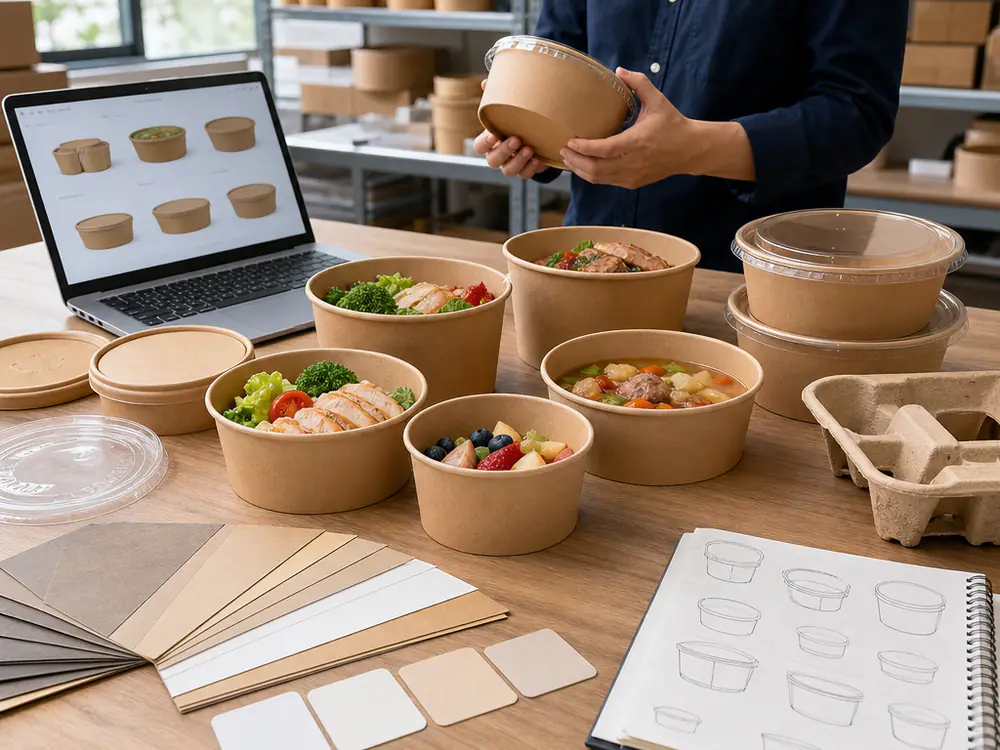
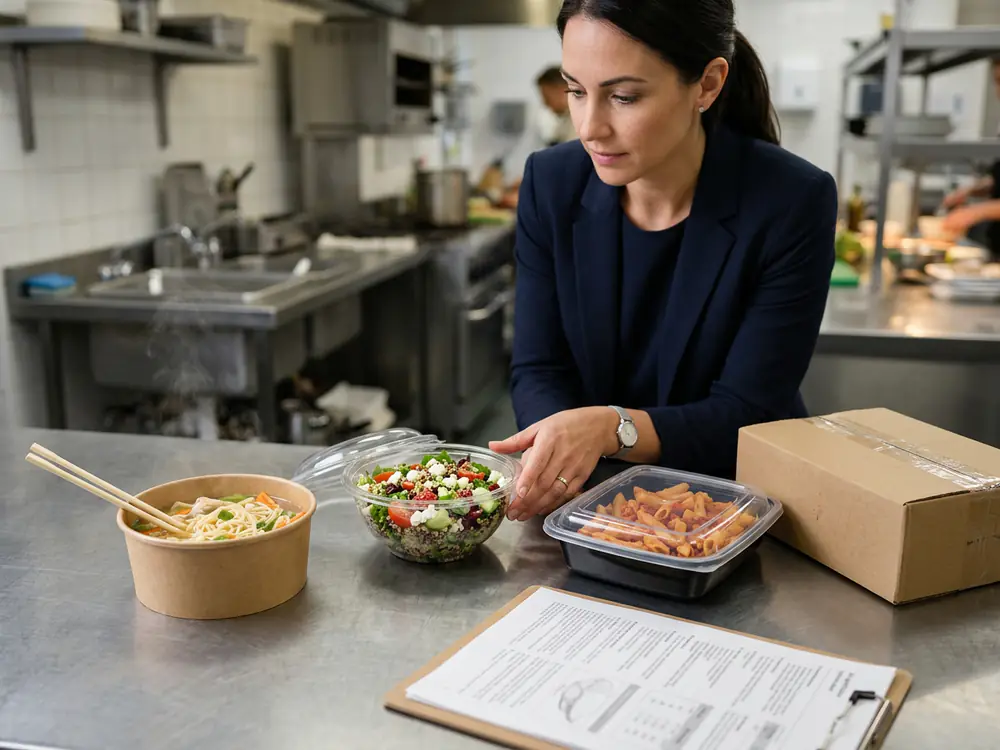
The outside color does not tell you whether a paper bowl is suitable for hot soup, oily noodles, chilled salad, rice, curry, sauce-heavy meals, or frozen dessert. Performance depends on the combination of paperboard strength, coating, forming quality, rim structure, heat sealing, and leak resistance.
For example, soup cups need heat resistance and reliable side-seam sealing. Salad bowls need stiffness, moisture resistance, and lid compatibility. Rice and sauce-based meals may require stronger oil and grease resistance. Dessert bowls may need clean appearance, good print quality, and odor control.
| Decision Factor | Why It Matters | Buyer Checkpoint |
|---|---|---|
| Food Type | Hot, oily, wet, chilled, or dry foods stress the bowl differently. | Share real menu items and filling temperature with the supplier. |
| Coating | PE, PLA, PP, or water-based coatings affect barrier performance and disposal route. | Confirm coating type, target market rules, and end-of-life claims. |
| Paperboard | Basis weight and stiffness affect stacking, holding feel, and delivery performance. | Test filled bowls under transport conditions. |
| Compliance | Food-contact safety involves paper, ink, coating, and additives. | Request relevant test reports and certification documents. |
A natural kraft appearance may support a sustainability-focused brand image, but environmental performance must be evaluated through the whole material system. PE-lined paper bowls, PLA-coated bowls, PP-coated structures, and water-based coatings each have different strengths and limitations. Buyers should also consider whether local recycling or composting systems can actually process the chosen structure.
Food-contact safety also requires attention. Ink migration, coating compliance, odor, grease resistance, and supplier quality control matter for both kraft and white paper bowls. A professional supplier should be able to explain material sources, coating options, production hygiene, inspection steps, and documentation for the target market.
MOQ, Printing Cost, Lead Time, and Inventory Planning

The substrate color alone rarely determines the final unit cost. Total cost is shaped by paper grade, coating, print coverage, bowl size, order quantity, SKU count, packing method, freight, and production efficiency.
Small brands, new product launches, and market tests usually need to control sampling cost and inventory risk. In this stage, fewer SKUs, simpler artwork, and standard sizes can be more important than choosing the lowest theoretical unit price. For stable, high-volume orders, custom paper bowls can be optimized through suitable paper selection, print method, coating structure, and production planning.
SKU planning is often underestimated. A 100,000-piece order may look large, but if it is divided across five sizes, three designs, and two languages, each SKU may become much smaller from a production perspective. This can affect MOQ, printing setup cost, color consistency, and lead time.
Econly’s production setup is designed for this type of B2B planning. With regular paper stock, coating lines for PE, PLA, and PP, six-color printing machines, die-cutting capacity, and cup and bowl forming lines, the production team can match branding requirements with manufacturing efficiency. The Thailand manufacturing base also gives international buyers another route to balance pricing, tariff exposure, and supply stability.
For buyers, the best approach is to discuss the full order structure early: bowl size, lid type, paper color, coating, print coverage, carton packing, destination market, forecast volume, and replenishment cycle. This allows the supplier to recommend a practical production route instead of quoting only from a basic image.
Decision Checklist: Is Kraft or White Paper Better for Your Food Brand?

The fastest way to choose between kraft paper bowls vs white paper bowls is to compare the packaging role in your brand system. Use the checklist below before confirming artwork or samples.
| Choose Kraft Paper Bowls When... | Choose White Paper Bowls When... |
|---|---|
| Your brand uses a natural or artisanal visual identity. | Your brand uses bright or highly controlled colors. |
| The design relies on dark, simple graphics. | The artwork includes gradients, photos, or light colors. |
| You want the substrate to remain visible. | You want a neutral background. |
| Minor paper-color variation is acceptable. | Cross-batch color consistency is critical. |
| The packaging range uses kraft bags and cartons. | The packaging system uses clean white visual elements. |
| The design intentionally limits ink coverage. | The branding requires large or detailed print areas. |
Before placing an order, confirm five practical points with your supplier:
- Brand color: Can the paper base reproduce your key Pantone colors within an acceptable tolerance?
- Food application: Is the bowl tested for your menu type, temperature, oil level, and holding time?
- Coating route: Does the coating match your barrier needs and sustainability claims?
- Order structure: Are MOQ, SKU count, and print setup costs calculated realistically?
- Market compliance: Are food-contact documents, certifications, and quality checks suitable for your destination market?
If your brand emphasizes natural texture, simple artwork, and an eco-conscious visual style, kraft paper bowls are worth testing. If your brand depends on vivid color, complex graphics, photography, or tight multi-location consistency, white paper food bowls are usually the more reliable starting point.
In the end, the best bowl is the one that fits both the customer-facing brand experience and the back-end supply chain. Request physical samples, review print proofs, test with real food, and compare production options before locking the specification for custom paper bowls.
References and Notes
- Bioleader: Kraft Paper vs White Paper Food Packaging – Visual Identity and Brand Perception back
- 3D Color: Color Accuracy in Packaging – Pantone Matching and Delta E back
- PubMed Central: Paper and Paperboard as Food Contact Materials – Migration and Safety Review back
- Bioleader: Custom Printed Paper Bowls Quality Control Guide back
- Bioleader: Kraft Paper Bowls & Food Containers – Natural Visual Language back
- Bioleader: Kraft vs White – Environmental Impact Considerations back
- PubMed Central: Food Contact Behavior of Paper Packaging back
- New Mexico State University: Color Reproduction for Printing – White Paper Advantage back
- 3D Color: Color Differences on Kraft vs White Substrates back
- Pantone: Color for Print and Packaging – Consistency Across Substrates back

Welcome to
the ECONLY Blogs!
Blogs Categories




Online Service

John Pan
Marketing Director

Seven Lee
Sales Manager
What are Econly gonna Do?
1st step: the use of professional knowledge and production capacity to provide quality products;
2nd step: optimize the product pain point, help to solve the customer's terminal sales problems;
3rd step: improve the selection of raw materials and technology level, improve the quality of life of buyers;
4th Step: profit feedback production and society, to create value for the cause of environmental protection.