
Kraft Paper Bowls vs Plastic Bowls: A B2B Cost and Performance Comparison for Takeaway Food Packaging
Sub Item 3 (H5)
Sub Item 4 (H6)
For B2B buyers, the question is rarely as simple as whether kraft paper bowls are better than plastic bowls. A restaurant chain, distributor, or foodservice brand must protect food quality, control cost, reduce complaints, support brand presentation, and respond to sustainability pressure at the same time.
Conclusion: Kraft paper bowls are often a strong choice for hot takeaway meals, custom branding, and a natural packaging appearance. Plastic takeaway bowls may be more practical for clear food display, some chilled applications, moisture resistance, and compact nesting. The better option depends on food temperature, holding time, delivery conditions, local waste infrastructure, and the total packaging system, not the bowl material alone.
In my work with food packaging buyers, I often suggest starting with the menu and channel before discussing material. A hot rice bowl, a cold salad, a soup delivery order, and a supermarket fruit cup should not be forced into one packaging answer.
There Is No Universal Winner: Start with the Food and Delivery Scenario
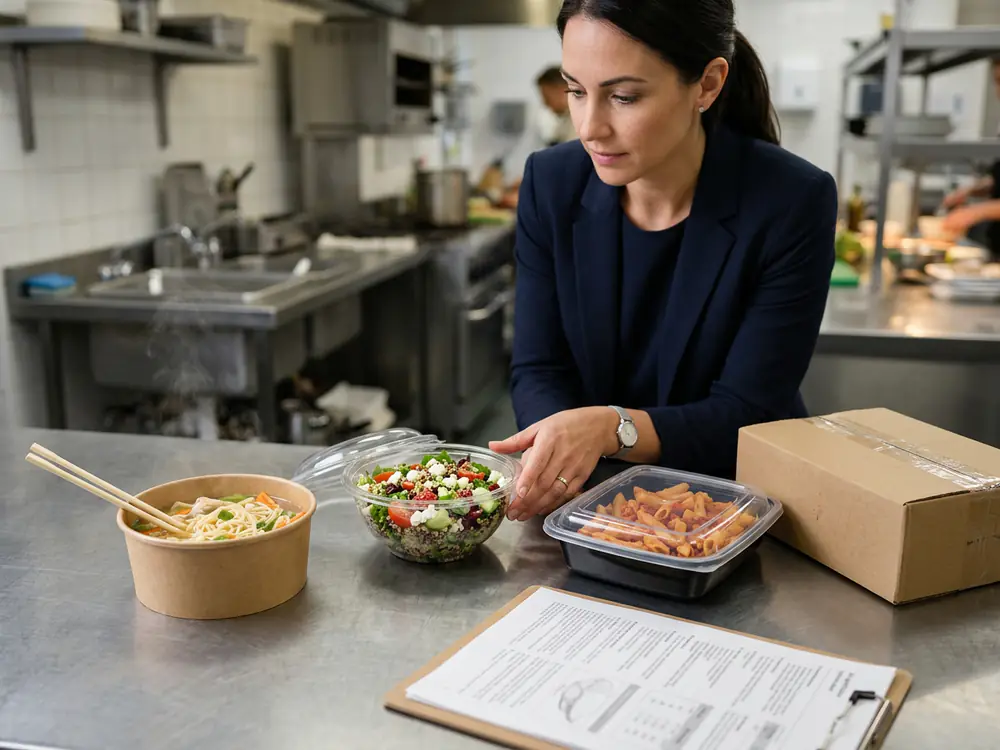
The most useful way to compare kraft paper bowls vs plastic bowls is to define the food application first. Paper and plastic are not abstract categories; they are packaging systems with different structures, coatings, lids, printing methods, and disposal paths.
For example, a coated kraft paper bowl may work well for a hot noodle bowl that is eaten within 30 minutes. A clear PET or rPET bowl may be better for a chilled salad sold in a retail cabinet, where visibility drives purchase decisions. A PP bowl may be selected for a meal-prep product that consumers may reheat.
| Selection factor | Questions buyers should ask |
|---|---|
| Food temperature | Is the food packed hot, chilled, or frozen? |
| Food composition | Is it oily, watery, acidic, or dry? |
| Holding time | How long will food remain in the container? |
| Delivery conditions | Will the bowl be tilted, stacked, or reheated? |
| Brand presentation | Is transparency or custom printing more important? |
Buyers should compare complete packaging systems for a defined menu item, not paper and plastic as broad material labels. A paper bowl with the wrong coating can fail. A plastic bowl with the wrong resin can deform. A lid that does not match the bowl rim can cause leakage even when the bowl itself is strong.
Heat Resistance, Moisture Control, and Food Safety: Where Paper and Plastic Bowls Have Limits

Heat, oil, water, and reheating conditions usually decide whether a packaging choice is safe and commercially reliable. Kraft paper bowls can be suitable for many hot foods when the board grade, coating, side seam, bottom seal, and lid are properly specified and tested.
Plastic bowls vary by resin. PP is commonly used for selected hot-food and reheating applications when tested for that use. PET and rPET are often chosen for cold food display because of their clarity, but they are generally not the starting point for microwave heating.
| Performance factor | Coated kraft paper bowls | PP bowls | PET/rPET bowls |
|---|---|---|---|
| Hot-food use | Suitable when properly specified and tested[1] | Common for selected hot-food uses | Generally better for cold applications[2] |
| Moisture resistance | Depends on coating and seam quality | Strong | Strong |
| Oil resistance | Depends on barrier coating | Generally strong | Generally strong |
| Microwave use | Confirm full structure | Possible for tested products | Usually not intended for microwave heating |
| Product visibility | Usually opaque | Transparent or opaque options | Often highly transparent |
| Leakage risk | Depends on side and bottom seals | Depends on molded structure and lid fit | Depends on molded structure and lid fit |
Food-contact safety cannot be judged from the words “paper” or “plastic” alone. Buyers should review the full material structure, intended food type, contact temperature, contact duration, inks, adhesives, coatings, and destination-market requirements.
For paper food containers, coating choice matters. PE, PLA, PP, and water-based coatings each affect heat sealing, oil resistance, moisture resistance, compostability claims, and recycling acceptance. For plastic takeaway bowls, resin identification, food-grade documentation, temperature guidance, and lid compatibility should be checked before approval.
Transparency, Brand Printing, and Consumer Perception: The Sales Value Is Different

Plastic bowls often win when the food itself needs to be seen.[3] Clear salad bowls, fruit cups, desserts, cold noodles, and grab-and-go meals benefit from transparency because consumers can judge freshness, color, portion size, and ingredient quality before purchase.
This is especially important for retail cabinets, convenience stores, airport food counters, and supermarket prepared-food sections. In these channels, the packaging is part of the shelf presentation. A clear bowl can reduce the need for large labels or extra product photography.
Kraft paper bowls create value in a different way.[4] They usually provide a larger printable exterior surface for logos, colors, patterns, menu concepts, QR codes, and brand messages. The kraft color also supports a natural, simple, healthy, or sustainability-led visual identity.
- Plastic bowl advantage: direct food visibility for salads, fruit, desserts, and chilled meals.
- Kraft paper bowl advantage: larger printable area for custom branding and visual consistency.
- Channel difference: retail shelves often need visibility, while delivery orders often need brand recognition and heat performance.
- Brand system impact: paper bowls can align with paper cups, paper bags, sleeves, and paper food boxes.
For brands that want strong custom printing, Econly can support paper bowl programs with custom sizes, structures, coating options, and six-color printing. This helps B2B buyers balance food performance, artwork quality, and consistent brand presentation across takeaway packaging lines.
Stacking Efficiency, Shipping Weight, and Total Cost: Do Not Compare Only Unit Price

The lowest-priced bowl is not always the lowest-cost packaging system. A small saving in unit cost can be lost through higher freight volume, poor nesting, lid failures, leakage, breakage, additional labels, slow store handling, or unstable replenishment.
Plastic bowls are often lighter, and some designs nest tightly.[5] This can help with long-distance transport, cold-food distribution, and warehouse efficiency. However, the cost of labels, separate branding materials, or resin price movement may affect the total calculation.
Kraft paper bowls may be heavier or take more carton volume depending on size and rim structure. But they can reduce the need for sleeves or large labels because the bowl itself can carry the brand message. They may also support a sustainability positioning that has commercial value for certain channels.
| Cost category | Examples to evaluate |
|---|---|
| Container cost | Bowl, lid, printing, labels |
| Logistics cost | Carton volume, pallet efficiency, freight |
| Storage cost | Nesting density, SKU count, warehouse space |
| Operational cost | Lid application speed, dispensing, staff handling |
| Failure cost | Leakage, deformation, breakage, refunds |
| Inventory cost | MOQ, replenishment lead time, safety stock |
| Brand cost | Printing, labels, sleeves, inconsistent presentation |
| Disposal cost | Local waste fees, recycling or composting requirements |
For wholesalers and importers, the practical question is whether the supplier can keep quality and delivery stable over repeat orders. Econly’s regular paper stock, coating lines, forming equipment, quality control team, and Thailand manufacturing base are relevant for buyers who need both customized paper food containers and supply continuity across markets.
Disposal and Compliance Risk: Paper Is Not Automatically Low-Impact, and Plastic Is Not Only About the Recycling Mark

Sustainable takeaway packaging must be evaluated by actual disposal infrastructure. Paper-based does not automatically mean widely recyclable. Acceptance depends on the coating, food contamination, and local recycling rules.
A kraft paper bowl with PE, PLA, PP, or another barrier layer may not enter a standard paper recycling stream in every market.[6] Compostable paper bowls may require industrial composting facilities, and if those facilities are not available, the expected environmental benefit can be reduced.[7]
Plastic bowls also require careful review. A recyclable resin mark does not guarantee that the item will be collected, sorted, cleaned, and recycled in the buyer’s target market.[8] Food residue, black pigments, mixed-material labels, and local sorting capability can all affect recovery.
- Confirm whether the bowl and lid are accepted by local recycling or composting systems.
- Check whether sustainability claims match the complete structure, not only the base material.
- Review food-contact compliance for the destination market before mass production.
- Avoid using “eco-friendly” as a blanket claim without disposal evidence.
For global B2B buyers, this means one packaging specification may not fit every country. A chain restaurant operating in several markets may need different paper, PP, PET, or compostable options depending on local waste handling and customer expectations.
How to Build a Packaging Mix: Match Paper Bowls, Plastic Bowls, and Custom Options to Each Channel

A practical packaging strategy usually uses more than one material. The goal is to match each menu item and channel with the right bowl, lid, coating, size, print method, and supply plan.
| Menu or channel | Likely starting option | Main reason |
|---|---|---|
| Hot rice and noodle delivery | Coated kraft paper bowl | Heat handling, branding, takeaway presentation |
| Soup delivery | Tested paper bowl and lid system or suitable PP system | Leakage and lid security are critical |
| Cold salad retail | Clear PET/rPET or paper bowl with clear lid | Product visibility |
| Premium branded takeaway | Custom printed paper bowl | Larger branding surface |
| Meal-prep and reheating | Tested PP system or validated paper structure | Reheating performance |
| Dessert and fruit display | Clear plastic bowl | Visual presentation |
| Sustainability-led program | Certified paper or compostable system | Must match local collection infrastructure |
| Multi-location restaurant chain | Standardized tested packaging system | Consistency, supply stability, inventory control |
Buyers should test the full system before placing large orders: bowl, lid, coating, printing, carton packing, stacking height, delivery simulation, and end-user handling. For custom paper bowls, it is also important to confirm artwork files, print tolerance, color expectations, rim fit, fill line, and carton labeling.
With Econly’s coating lines for PE, PLA, and PP, six-color printing machines, forming capacity, and quality control process, B2B customers can develop paper food containers that fit specific menu and market requirements instead of relying only on standard stock sizes.
FAQs About Kraft Paper Bowls and Plastic Bowls
Q: Are kraft paper bowls better than plastic bowls?
A: Not always. Kraft paper bowls are often better for hot takeaway meals, custom printing, and natural brand presentation. Plastic bowls may be better for clear display, cold food, high moisture resistance, or compact nesting. The right choice depends on material type, food application, full packaging structure, test conditions, and local disposal infrastructure.
Q: Which type of bowl is better for hot takeaway food?
A: Coated kraft paper bowls can work well for many hot foods when properly specified and tested. PP bowls are often considered for hotter, oilier, or reheating applications. Buyers should confirm temperature limits, holding time, lid fit, leakage performance, and food-contact compliance before ordering.
Q: Which bowl is better for salads and cold food?
A: Clear PET, rPET, or clear PP bowls are often strong options for salads, fruit, desserts, and chilled meals because shoppers can see the food. Paper bowls with clear lids can also work when branding and sustainability positioning are important.
Q: Do paper bowls leak more easily than plastic bowls?
A: Leakage depends on structure, not only material. Paper bowl leakage is affected by coating, side seam, bottom seal, and lid fit. Plastic bowl leakage depends on molded accuracy, rim design, lid lock, and transport conditions. Always test with the actual food.
Q: Should restaurants use both paper and plastic bowls?
A: Many brands should. A mixed packaging system can use kraft paper bowls for hot branded takeaway and plastic bowls for cold display or reheating needs. This approach is often more realistic than forcing every menu item into one material.
Final conclusion: The best takeaway packaging decision is not “paper or plastic” in isolation. It is a menu-based packaging matrix that balances food safety, heat resistance, moisture control, shelf presentation, custom branding, logistics, cost, and disposal reality. Before committing to mass production, buyers should request samples, test the full bowl-and-lid system with real food, compare total landed cost, and discuss custom specifications with a supplier that can support both product development and stable supply.
References and Notes
- Dashan Packing - Kraft Paper Bowls vs Plastic Bowls: A Practical Comparison for 2025 Food Packaging back
- Bolooming - Why Are PET Clear Salad Containers Preferred? back
- YRPak - Analysis of the Advantages and Disadvantages of Plastic Serving Bowls back
- Biobased Press - Why Paper Packaging Is Better for the Environment Than Plastic back
- Atlas Container - How Packaging Choices Impact Your Supply Chain Efficiency back
- Republic Services - Are Takeout Containers Recyclable? back
- Pandapak - Compostable Paper Bowls back
- National Restaurant Association - How to Transition to More Sustainable Food Packaging back

Welcome to
the ECONLY Blogs!
Blogs Categories




Online Service

John Pan
Marketing Director

Seven Lee
Sales Manager
What are Econly gonna Do?
1st step: the use of professional knowledge and production capacity to provide quality products;
2nd step: optimize the product pain point, help to solve the customer's terminal sales problems;
3rd step: improve the selection of raw materials and technology level, improve the quality of life of buyers;
4th Step: profit feedback production and society, to create value for the cause of environmental protection.