
If you buy packaging for restaurants, wholesalers, distributors, or food delivery brands, kraft paper bowls are not just another disposable item. The right bowl affects how fast your team packs orders, how well food holds during transport, how many SKUs you need to manage, and how often customers complain about leaks or weak lids. For B2B buyers, the best choice is not the cheapest bowl. It is the bowl that matches the menu, serving temperature, delivery distance, compliance requirements, and supply plan.
Conclusion: The most reliable way to buy kraft paper bowls is to define the food application first, then choose the right size, board weight, coating, lid system, printing method, and supplier. That approach lowers risk, improves performance, and gives you a better total cost than chasing the lowest unit price.
In practice, that means reviewing the bowl as part of a complete packaging system, not as a single product line.
Why Kraft Paper Bowls Matter in Takeaway Foodservice Operations
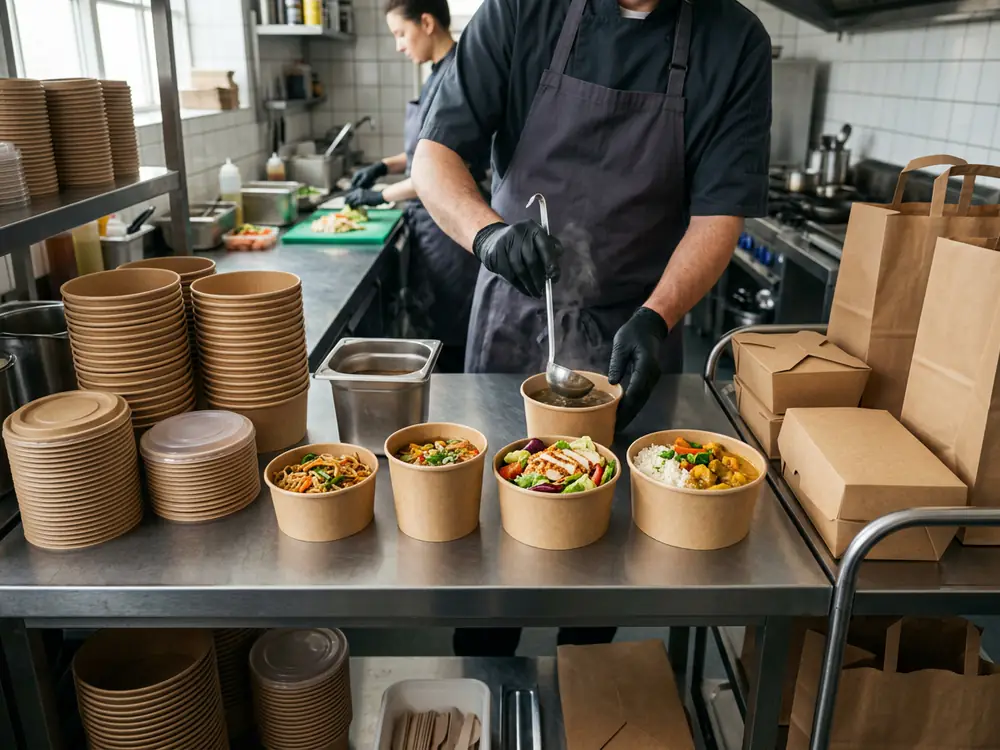
Kraft paper bowls matter because they sit at the center of daily foodservice execution. A good bowl helps kitchens pack faster, keeps soup and noodles from leaking, supports hot and cold menu items, and presents the brand in a cleaner way at the point of delivery. A poor bowl creates operational friction, from collapsed walls and loose lids to wasted stock and customer complaints.
For takeaway operators, disposable paper bowls are often used for salad, soup, rice bowls, noodles, poke, grain bowls, and ready-to-eat meals. These are high-frequency menu items, so even a small packaging failure can create a repeat problem across thousands of orders[1]. That is why B2B buyers should think in terms of service performance, not just appearance.
The real business value comes from five areas:
- Faster packing: standardized bowl sizes reduce confusion at the packing line.
- Better delivery performance: stronger walls and matching lids reduce spills and damage.
- Food quality retention: the right structure helps keep food warm, stable, and presentable.
- Lower SKU pressure: fewer bowl and lid combinations simplify inventory.
- Brand consistency: custom printing turns packaging into a visible brand asset.
Buyers also need to remember that sustainability claims now affect procurement. Many foodservice brands want packaging that supports their ESG story, but that claim only works if the bowl material, coating, and end-of-life route are aligned with local regulations and waste infrastructure[9]. In other words, a kraft paper bowl should solve an operational problem first and a branding problem second.
How to Match Bowl Size, Capacity, and Shape to Your Menu
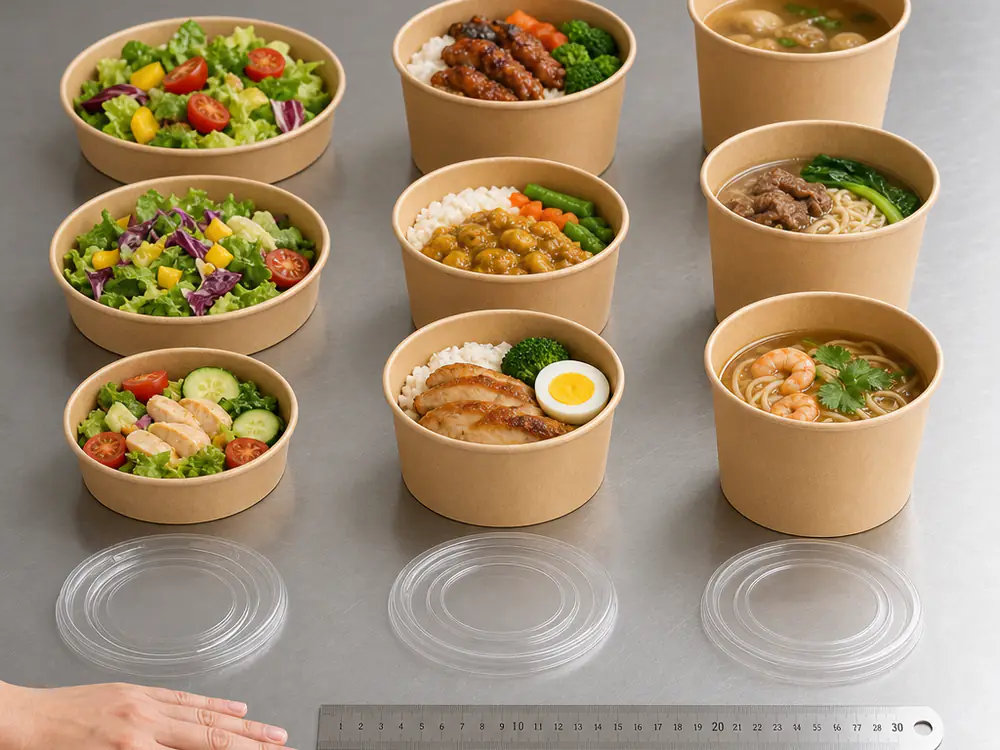
The best bowl size depends on the food, the portion, the holding time, and the delivery distance. Buyers should select the bowl according to the menu and use conditions, not by choosing the lowest price per piece. If the bowl is too small, food will sit too high and spill. If it is too large, you pay for unnecessary material and lose presentation quality.
As a practical rule, soup, noodles, rice bowls, salads, and family portions usually need different bowl heights and diameters. A broad, shallow bowl may work well for salads and cold bowls, while deeper formats are better for broth-based foods and long-distance delivery. Capacity is important, but bowl opening diameter and wall depth matter just as much because they affect stability and lid fit.
| Menu Type | Typical Capacity | Shape Priority | Common Lid Need |
|---|---|---|---|
| Side dishes, desserts, tasting portions | 8-12 oz | Compact, shallow | Flat lid or light snap-fit lid |
| Soup, porridge, single noodles | 16-26 oz | Deeper bowl for liquid retention | Secure lid with strong rim fit |
| Rice bowls, poke, grain bowls | 26-32 oz | Balanced width and depth | Stable lid for transport |
| Large meals, share portions | 32-40 oz | Wide opening, reinforced wall | High-retention lid or dome lid |
For most foodservice operators, three core sizes cover most demand[2]. That is often better than carrying too many SKUs. If you can standardize around a small set of bowl diameters, you can often reduce lid complexity as well. That makes procurement easier, lowers warehouse pressure, and gives the kitchen fewer choices to manage during busy hours.
When comparing oz and ml specifications, do not focus only on the number. Two bowls with the same nominal capacity can perform differently because of height, rim width, and taper. For B2B buyers, the sample should always be tested with the real menu item, not just water. Soup, oily sauces, and mixed ingredients behave differently from a simple volume test.
Paperboard GSM, Bowl Construction, and Leak-Resistance Performance

Paperboard GSM influences stiffness, wall strength, and resistance to deformation. In general, higher GSM improves rigidity, but it is only one part of the performance equation. Fiber quality, coating, forming accuracy, and rim construction all affect how a kraft paper bowl performs in real use.
For foodservice bowls, common paperboard weights usually fall in a medium-to-high range that balances strength and cost[3]. Lighter board may be acceptable for dry or cold foods, but hot soup, oily dishes, and long delivery times call for a stronger structure. If the board is too light, the bowl can soften, bow outward, or lose shape once heat and moisture build up.
Construction also matters. Single-wall bowls are often suitable for cold food or lower-risk applications. Double-wall formats are better for hot soups, noodles, and items that need more insulation. A double-wall bowl is usually more comfortable to hold and can reduce the need for extra sleeves or double-cupping, which improves packing speed.
Leak resistance depends on more than the coating. A strong bowl should have:
- Consistent sidewall forming.
- Clean rim rolling or finishing.
- Stable bottom sealing.
- Coating coverage that matches the food application.
- Enough structural stiffness to keep the lid seal intact during handling.
In buyer terms, the best test is simple: fill the bowl with the actual product, seal it, tilt it, hold it warm, and move it as it would move in real delivery. If the bowl passes in the lab but fails in a driver bag, it is not good enough for commercial use.
Coatings and Sustainability Claims: How to Choose Between PE, PLA, and Water-Based Options

Coating choice should be based on food performance, local regulations, certification needs, and the waste-management systems available in the destination market. A coating is not just an environmental label. It is a functional layer that controls moisture resistance, oil resistance, heat performance, and how the bowl will be treated after use[4].
PE coating is widely used because it gives reliable moisture resistance and strong general performance. It is often a practical choice for hot soup, greasy foods, and markets where performance and cost are the main priorities. PLA coating is usually chosen when brands want a compostable positioning, but buyers must confirm whether the target market actually has industrial composting infrastructure. Water-based coating can support a more paper-like feel and may fit certain recycling claims better, but the final choice depends on local recycling rules and the exact food performance requirement.
| Coating Type | Main Strength | Typical Use | Buyer Caution |
|---|---|---|---|
| PE | Reliable moisture and grease resistance | Hot soup, noodles, mixed meals | Check recycling claims carefully by market |
| PLA | Supports compostable positioning | Cold bowls and selected hot applications | Requires suitable composting infrastructure |
| Water-based | Improved paper feel and certain recycle pathways | Dry-to-medium moisture foods | Performance varies by formula and use case |
For B2B buyers, the key mistake is to choose the coating based on the marketing message alone. A compostable claim is only useful if the end market can process the item correctly. A recyclable claim is only useful if the local recovery system accepts the material structure. If the route at end of life is unclear, the environmental message becomes weak and sometimes misleading.
That is why coating discussions should always include the food use case, the destination country, the expected disposal path, and the documents your sales team will need to support the claim[5]. If your brand sells across several markets, one coating may not be ideal for all regions.
How to Choose Kraft Paper Bowls with Lids for Takeaway Use

For takeaway bowls with lids, the bowl and lid should be tested and purchased as one system rather than evaluated as two separate products. A lid that looks compatible on paper may still fail under heat, steam, tilt, or stacking pressure.
The first issue is rim compatibility. The lid must lock onto the exact bowl diameter and rim profile. Even small dimensional differences can cause weak retention, leakage, or a lid that pops off in transit. The second issue is steam management. Hot food creates condensation, and if the lid does not vent properly, the inside can become soggy or unstable.
Different lid types suit different use cases:
- Flat lids: useful for stackability and simple cold applications.
- Dome lids: better when food volume sits above the rim.
- Paper lids: useful for paper-forward branding and some hot food programs.
- PET or PP lids: often chosen when visibility and tight closure are important.
Buyers should also test the lid under realistic handling conditions. Check whether it stays secure when tilted, whether it leaks in a delivery bag, whether it stacks cleanly, and whether it remains easy for staff to close during rush periods. The best lid is not only tight. It is also fast to apply.
Inventory management matters too. If you use many bowl sizes with separate lids, the supply chain becomes more fragile. Standardizing on a smaller number of rim sizes can reduce the chance of mix-ups and make replenishment much easier. For chain restaurants and distributors, that consistency is often worth more than a slightly lower price on an individual item.
Customization and Purchasing Terms: Printing, Compliance Documents, MOQ, Lead Time, and Quotes

Once the bowl format is defined, the next step is to make the purchase order executable. That means confirming the artwork, compliance documents, order size, production window, and shipping plan before you approve mass production. In B2B packaging, good specification control prevents most downstream problems.
Printing affects both brand image and production complexity. More colors, larger print coverage, and special placement usually increase cost and may extend lead time. Buyers should send print-ready artwork, clear logo files, and exact placement requirements. If your brand uses multiple regional menus, check whether the same base bowl can support several artwork versions without creating too many variants.
Before release to production, ask for the following documents or confirmations:
- Food-contact compliance files and test reports.
- Declaration of conformity where required.
- FSC or other material-origin documents if the claim is needed.
- Artwork proof and dieline confirmation[6].
- Sample approval for size, color, and lid fit.
MOQ and lead time depend on bowl size, coating, print complexity, available stock, and order combination. For custom projects, many buyers should expect a production window measured in weeks, not days. If several SKUs are combined in one order, planning becomes more important because each variant can affect setup and packing efficiency. Freight planning matters as well, especially for oversized bowls that take more container space than buyers expect.
For large B2B accounts, I often advise looking at total landed cost instead of only the factory quote. Landed cost includes product price, packaging, container loading efficiency, inland transport, customs handling, and the risk of emergency replenishment. A slightly higher unit price can still produce a lower total cost if the supplier is organized and the production plan is stable.
How to Evaluate Kraft Paper Bowls Wholesale Suppliers

The supplier decision should be based on manufacturing capability, quality control, documentation, delivery reliability, and long-term supply stability. If a supplier only trades products, they may not be able to control paper sourcing, coating stability, print consistency, or lid compatibility with enough precision for a large account.
A strong kraft paper bowls wholesale supplier should be able to demonstrate:
- Control over paper sourcing and inventory.
- Coating, printing, die-cutting, and forming capability in-house or under tight control.
- Clear inspection steps for incoming materials and finished goods.
- Stable production capacity for peak-season demand.
- Documented food-contact compliance and traceability[7].
- Consistent color control and dimensional tolerance management.
- Support for samples, revisions, and complaint handling.
This is where manufacturing scale matters. At Econly, for example, we operate a 73,000 square meter production base in China, supported by five coating lines, four six-color printing machines, more than 20 die-cutting machines, and 140-plus paper cup and bowl forming machines[8]. We also expanded production in Thailand, which helps large buyers reduce tariff exposure and diversify supply routes without sacrificing stability.
From a buyer's perspective, that kind of setup matters because it reduces single-point risk. If one production route is under pressure, alternative capacity can support continuity. If demand spikes in a specific region, a second manufacturing base can help stabilize lead times. For wholesalers, distributors, and chain restaurants, that is often more valuable than a small price difference.
Quality control should also be visible, not just promised. A serious supplier should inspect raw paper, monitor coating performance, confirm lid fit, and check printing consistency across the order. The buyer should ask how the supplier handles batch traceability, how nonconforming goods are isolated, and how rework or replacement is managed. Those questions tell you more than a polished catalog ever will.
If you are comparing suppliers for long-term kraft paper bowls wholesale supply, use the same scorecard for every candidate: product fit, compliance, capacity, lead time, communication speed, and backup supply options. That keeps the discussion on total value instead of invoice price alone.
FAQs About Buying Kraft Paper Bowls in Bulk
Q: What size kraft paper bowl is best for soup or noodles?
A: Most soup and noodle programs start around 16-26 oz, but the right size depends on portion weight, broth volume, and whether the bowl needs to travel far. Deeper bowls are usually better for liquid-heavy foods. Always test with the actual recipe, not just water.
Q: Are kraft paper bowls suitable for hot and oily food?
A: Yes, but only if the board, coating, and structure are matched to the food. Hot soup, greasy noodles, and saucy meals need stronger resistance than dry snacks or salads. The bowl should be tested under heat, steam, and tilt conditions before approval.
Q: How do I test whether a lid fits a paper bowl correctly?
A: Check the fit on the exact production sample, then fill the bowl, seal it, tilt it, stack it, and move it as it would move in delivery. A good fit should stay secure without leaking, warping, or popping off when the bowl is warmed.
Q: What is the difference between PE- and PLA-coated kraft paper bowls?
A: PE coating usually offers more familiar moisture resistance and broad practicality. PLA coating is often used for compostable positioning, but only makes sense if the target market has the right waste-processing setup. The best choice depends on food type, regulations, and disposal path.
Q: What documents should a paper bowl supplier provide?
A: Ask for food-contact compliance documents, test reports, declarations where needed, FSC or material-origin documents if relevant, and approved artwork or dieline files. For branded orders, sample confirmation and production specifications are also important.
Conclusion
Kraft paper bowls are a simple product only on the surface. For B2B buyers, they sit at the intersection of menu design, packaging performance, compliance, and supply reliability. The best buying decision starts with the food application, then moves through size, board weight, coating, lid compatibility, printing, documents, MOQ, and lead time. That process helps you avoid leaks, reduce SKU complexity, and protect the customer experience.
If you are sourcing kraft paper bowls wholesale for a brand, distribution network, or restaurant chain, the safest approach is to request a sample against real menu conditions and compare suppliers on total supply value, not just unit price. In foodservice packaging, the right specification is usually the one that performs well every day, not the one that looks cheapest on a quote sheet.
References and Notes
- Strategic Market Research - Takeaway Containers Market back
- Bioleader - Paper Bowl Sizes, MOQ, and Container Loading back
- Good Start Packaging - Paper Bowls back
- Intertek - Paper and Paperboard Food Contact Compliance back
- Compliance Gate - EU Declaration of Compliance for Food Contact Materials back
- Bioleader - Custom Printed Paper Bowls Quality Control back
- Bioleader - 2025 Kraft Paper Bowl Manufacturer Buying Guide back
- Bioleader - Top 12 Kraft Bowls Suppliers and Manufacturers in China back
- FSC - Paper and Packaging for Businesses back

Welcome to
the ECONLY Blogs!
Blogs Categories




Online Service

John Pan
Marketing Director

Seven Lee
Sales Manager
What are Econly gonna Do?
1st step: the use of professional knowledge and production capacity to provide quality products;
2nd step: optimize the product pain point, help to solve the customer's terminal sales problems;
3rd step: improve the selection of raw materials and technology level, improve the quality of life of buyers;
4th Step: profit feedback production and society, to create value for the cause of environmental protection.